How Long to Learn Spoken English? Fluency Timeline
Every learner asks the same question on day one: how long to learn spoken English before real conversations feel easy? The honest answer is that it depends, but it is not a mystery. With a clear plan, steady daily practice hours, and realistic expectations, you can follow a beginner to fluent timeline and measure your progress along the way.
This guide explains how long to learn spoken English at every level, which factors speed you up or slow you down, and how a smart course structure keeps you moving.
How Long to Learn Spoken English: The Short Answer
If you want a number, here it is. For most adults starting from zero, how long to learn spoken English comfortably usually falls between 12 and 24 months of consistent study. Basic survival conversation can arrive in two to three months, while confident professional fluency often takes 18 to 30 months.
Why such a wide range? Because how long to learn spoken English depends on your starting level, your native language, your schedule, and the quality of your practice. Someone who speaks for one focused hour daily will usually progress faster than someone who studies grammar for five hours once a week.
Speaking is a skill, not a subject, so it grows through active repetition.
English Fluency Timeline by Level
This English fluency timeline uses the CEFR scale, which most schools and employers recognize. Hours are guided learning plus self-study, based on common language-institute estimates.
| Level | What You Can Do | Approximate Total Hours | Typical Time at 1 Hour/Day |
| A1 Beginner | Introduce yourself, ask simple questions | 60–100 | 2–3 months |
| A2 Elementary | Handle shopping, travel, daily routines | 150–200 | 4–6 months |
| B1 Intermediate | Discuss work, opinions, past events | 300–400 | 8–12 months |
| B2 Upper-Intermediate | Speak spontaneously with native speakers | 500–600 | 14–18 months |
| C1 Advanced | Express complex ideas fluently | 700–800 | 20–26 months |
Treat this English fluency timeline as a map, not a promise. Anyone asking how long to learn spoken English should remember that two learners with the same hours can still finish months apart.
Beginner to Fluent Timeline: Stage by Stage
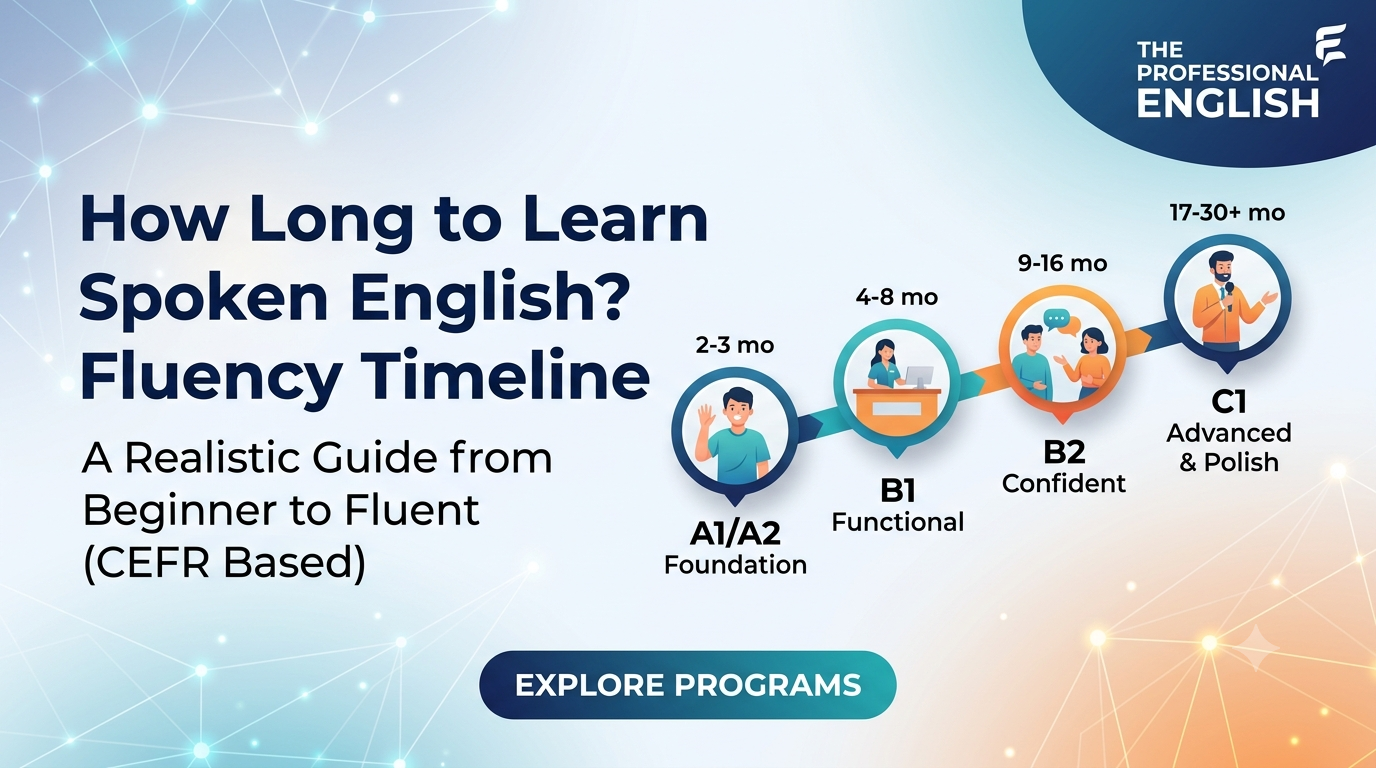
A realistic beginner to fluent timeline has four stages, and each beginner to fluent timeline stage feels different. Knowing where you are keeps motivation high, because each stage feels different.
Stage 1: Foundation (Months 1–3)
This stage sets the pace for how long to learn spoken English overall. You learn core vocabulary, greetings, simple sentence patterns, and pronunciation basics. Speaking feels slow and awkward, and that is normal. Focus on common words and short daily speaking drills.
Stage 2: Functional Speaking (Months 4–8)
Now you can survive real situations: ordering food, asking directions, introducing your job. Mistakes are frequent, but people understand you. This stage answers a big part of how long to learn spoken English for everyday life.
Stage 3: Confident Conversation (Months 9–16)
You stop translating in your head as often. You can share opinions, tell stories, and join workplace discussions. Your beginner to fluent timeline accelerates here because vocabulary and listening finally reinforce each other.
Stage 4: Fluent and Natural (Months 17–30)
By now, how long to learn spoken English has become a question of polish, not survival. You speak with rhythm, handle surprises, understand fast speech, and adapt your tone to the audience. Polishing idioms, accent clarity, and professional vocabulary are the main goals.
Daily Practice Hours: How Much Is Enough?
Your daily practice hours are the single most controllable part of how long to learn spoken English. Consistency beats intensity, but total volume still matters, so plan your daily practice hours carefully.
Here is a practical guide:
- 30 minutes per day: Steady progress, but expect the upper end of every timeline.
- 1 hour per day: The sweet spot for most learners. You can reach B2 in roughly 14 to 18 months.
- 2 hours per day: Faster results, often cutting the English fluency timeline nearly in half.
- 3+ hours per day: Possible with immersion learning, but only if the time includes speaking, not just studying.
How to Split Your Daily Practice Hours
An effective one-hour routine might look like this:
- Ten minutes of pronunciation or shadowing a short audio clip.
- Twenty minutes of active speaking with a tutor, partner, or recording yourself.
- Fifteen minutes of listening to podcasts or videos at your level.
- Fifteen minutes of reviewing new words and phrases aloud.
Notice that most of the time is spoken or heard English. Learners who ask how long to learn spoken English often forget that reading about speaking will not build speaking.
Immersion Learning Without Moving Abroad
Immersion learning means surrounding yourself with English so your brain meets it constantly. You do not need to live in London or New York to try it.
Simple Immersion Learning Habits
- Change your phone, apps, and social media to English.
- Watch shows with English subtitles, then without them.
- Narrate your day in English while cooking or commuting.
- Join online speaking clubs or conversation groups.
Immersion learning can shorten how long to learn spoken English by several months, because it multiplies exposure without adding formal study time. However, immersion alone is not magic. Without correction and structure, learners can fossilize mistakes, repeating the same errors for years. The best results come from combining immersion learning with guided lessons and a clear course structure.
Realistic Expectations: What Fluency Really Means
Setting realistic expectations protects you from burnout, and realistic expectations keep motivation alive. Many learners quit because they expected to sound like a native speaker. That expectation, not lack of talent, is the real danger.
Fluency does not mean perfection. It means you can communicate ideas smoothly, recover when you forget a word, and understand most conversations.
Keep these realistic expectations in mind as you plan your daily practice hours:
- Progress is uneven. Expect plateaus after the first big jump.
- Confidence comes before accuracy. Speak first, polish later.
- Your goals matter. Travel English needs fewer hours than negotiating contracts.
When you ask how long to learn spoken English, define “fluent” first. Fluent for ordering coffee is a very different target than fluent for leading meetings.
Factors That Change Your English Fluency Timeline
Several variables decide how long to learn spoken English for you specifically:
- Native language: Spanish or French speakers often move faster because of shared vocabulary. Speakers of languages with different sounds may need extra pronunciation work.
- Motivation: A job promotion or visa goal keeps people practicing on hard days.
- Feedback quality: Regular correction from a teacher can save months of repeated mistakes.
Course Structure That Shortens Your Journey
A strong course structure is the difference between wandering and progressing. When people ask how long to learn spoken English, the answer shrinks dramatically with a well-built plan.
A good course structure includes:
- A placement test so you start at the right level instead of repeating basics.
- Clear level goals such as “hold a five-minute conversation” instead of vague targets.
- Weekly speaking time with live feedback from a qualified teacher.
- Spaced review so vocabulary moves into long-term memory.
- Monthly progress checks to measure fluency, not just test scores.
Choose a course structure that puts speaking at the center and tracks real progress each week. At The Professional English, programs are designed around real situations such as interviews, meetings, presentations, and everyday conversation, so every lesson transfers directly to life.
If you study alone, you can borrow the same ideas. Write down weekly goals, schedule speaking sessions, and track your progress in a notebook. A simple course structure you follow beats a perfect plan you abandon.
Common Mistakes That Slow Down Your English Fluency Timeline
Avoid these habits and you will protect your English fluency timeline:
- Studying grammar without speaking. Rules help, but conversation builds fluency.
- Skipping review. Forgotten words add months to how long to learn spoken English.
Conclusion: Your Personal Fluency Timeline
So, how long to learn spoken English? For most adults, about 12 to 24 months of consistent, speaking-focused practice leads to confident conversation, and professional fluency may take a little longer. Your own answer depends on daily practice hours, immersion learning, realistic expectations, and a course structure that keeps you accountable.
Explore the programs at The Professional English and take your first step toward confident spoken English today.