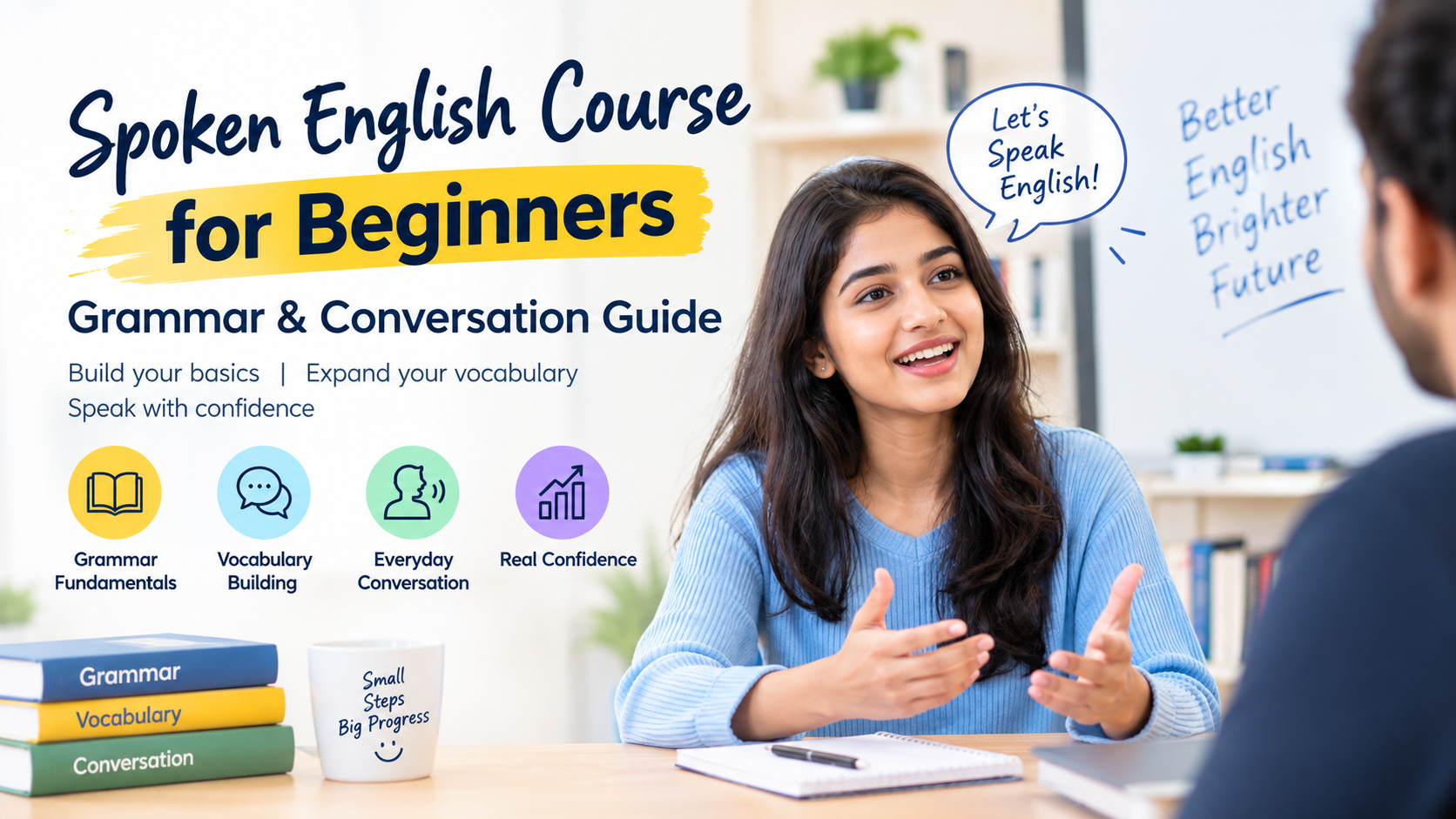
Spoken English Course for Beginners | Grammar & Conversation Guide
You’ve decided to finally learn English. Good. Now comes the hard part — figuring out which spoken English course for beginners is actually worth your time and money. Delhi alone has dozens of institutes promising fluency in “30 days,” and honestly, most of that is marketing noise. A real spoken English course for beginners doesn’t just throw vocabulary lists at you. The right spoken English course for beginners builds a foundation you can actually use, not just a certificate you can frame. It builds grammar fundamentals, trains your ear for everyday conversation, and — this is the part everyone skips — actually gets you talking out loud, mistakes and all.
At The Professional English in Delhi, we’ve watched learners walk in nervous about ordering coffee in English and walk out three months later handling job interviews without flinching. That transformation isn’t magic — it’s structure. This guide breaks down what a good basic english speaking course should cover, why grammar fundamentals matter, and how vocabulary building and sentence formation work together toward real confidence building.
kes a Good Spoken English Course for Beginners?
Here’s the thing: not every english course for beginners is built the same way. Some focus entirely on grammar drills; others throw you into conversation on day one with no foundation. Neither works well alone.
A properly structured spoken english course for beginners combines three things — grammar fundamentals, active vocabulary building, and guided everyday conversation — in a sequence that makes sense. Learn the rule, get the vocabulary, then practice it in a real conversation, not a worksheet.
Think about how a child learns to speak — nobody hands a toddler a grammar textbook. They hear words, copy sounds, get corrected, and try again. Adult learners just handle explicit rules faster than toddlers do.
What should you look for?
- A clear beginner-to-intermediate roadmap, not a vague “learn at your own pace” promise
- Live speaking practice, not just recorded video lessons
- Grammar taught through usage, not memorization
- Regular feedback on pronunciation and sentence formation
- A trainer who actually corrects you in real time
Skip any spoken english course for beginners that doesn’t offer live correction. Watching videos alone builds comprehension, not speech — and that’s exactly why so many Indians read English fluently but freeze up in a meeting. The real test: does it make you talk, or just make you watch?
Grammar Fundamentals: The Skeleton of Spoken English
Grammar has a bad reputation. Most people associate it with red ink on school notebooks and boring rule charts. But in any spoken english course for beginners, grammar fundamentals aren’t the enemy of fluency — they’re what makes fluency possible.
Here’s why it matters: without grammar, “yesterday I go market” replaces “yesterday I went to the market.” People will understand you, sure, but it marks you instantly as a beginner — and in a job interview, that impression sticks.
A well-designed spoken english course for beginners teaches grammar fundamentals in digestible chunks:
- Tenses — present, past, and future, taught through daily-life examples
- Subject-verb agreement — small errors that quietly undercut confidence
- Articles (a, an, the) — a genuine pain point for regional-language speakers
- Prepositions — “in,” “on,” “at” trip up even advanced learners
- Question formation — how to actually ask, not just answer
We don’t teach grammar as theory at The Professional English. Every rule gets tied to a real sentence you’ll use that same week. Learn the past tense on Monday, use it describing your weekend by Wednesday. That’s how grammar fundamentals stop being rules and start being habits — and it’s the backbone of any spoken english course for beginners worth enrolling in.
Vocabulary Building That Sticks
Rote memorization doesn’t work. You’ve probably tried it — twenty new words a day, forgotten by the weekend. In any spoken english course for beginners, vocabulary building only sticks when words are learned in context, used immediately, and revisited across conversations.
A smart basic English speaking course groups vocabulary by situation, not alphabet — words for the workplace, words for shopping, words for small talk at a wedding. This context-first approach to vocabulary building means you’re preparing for a specific moment, not memorizing a random list.
Try this: pick five new words each day tied to something you’re already doing. Cooking dinner? Learn “simmer,” “season,” “chop,” “stir,” “garnish,” then use all five in one sentence before bed. That’s vocabulary building with a purpose — exactly what any decent spoken english course for beginners should push you toward.
Word families help too. Learn “confident,” and pick up “confidence,” “confidently,” and “self-assured” in the same breath. One root, four usable words. That’s efficient vocabulary building, and it compounds fast. Any spoken english course for beginners that skips this word-family technique is leaving easy progress on the table.
Sentence Formation: Turning Words Into Meaning
Knowing words isn’t the same as forming sentences — this trips up more beginners than anything else in a spoken english course for beginners. You know “yesterday,” “office,” “late,” and “reach,” but can you say “I reached the office late yesterday” without hesitating?
Sentence formation is a skill, and like any skill, it needs repetition. The standard structure in English — subject, verb, object — feels foreign if your first language follows a different order. This is precisely why a good spoken english course for beginners drills the pattern until it becomes automatic, not something you consciously calculate mid-sentence.
Here’s a simple sentence formation ladder we use in class:
| Level | Example Sentence | Skill Practiced |
| Basic | “I am a student.” | Simple present, subject-verb-complement |
| Intermediate | “I have been studying English for two months.” | Present perfect continuous |
| Everyday | “Could you please repeat that? I didn’t catch it.” | Polite requests, natural phrasing |
Notice how the “Everyday” example isn’t grammatically fancy — it’s just what people actually say. That’s the real goal of sentence formation practice in any basic english speaking course: not textbook perfection, but natural, confident speech that gets your point across without stalling. This is exactly the skill a solid spoken english course for beginners drills week after week.
Everyday Conversation: Where Theory Meets Real Life
This is where most english course for beginners programs fall short. They teach grammar and vocabulary in isolation and assume everyday conversation will magically follow. It doesn’t — conversation is its own skill: reading tone, responding quickly, recovering from mistakes without freezing.
A genuinely effective spoken english course for beginners builds everyday conversation practice into every single class, not once a week. Role-plays for ordering food, calling customer care, introducing yourself at a networking event — situations you’ll actually face in Delhi or wherever you work.
What makes everyday conversation practice effective?
- Realistic scenarios, not scripted dialogues you memorize
- Immediate correction, so mistakes don’t calcify into habits
- Repetition across contexts, using the same grammar in different situations
- Low-pressure environments, because fear kills fluency faster than mistakes do
Here’s an opinion worth stating plainly: if your english course for beginners doesn’t have you speaking out loud within the first week, you’re wasting your time. Fluency comes from talking, not from watching someone else talk. A spoken english course for beginners that delays speaking practice is, frankly, not doing its job.
Confidence Building: The Part Nobody Talks About Enough
You can know every grammar rule and still freeze the moment someone asks you a question in English. That’s not a knowledge problem — it’s a confidence problem, and arguably the biggest barrier for adult learners in India.
Confidence building isn’t a separate module bolted onto a spoken english course for beginners — it has to be woven through every class. Small wins matter: finishing a two-minute conversation without switching to Hindi, ordering food and actually being understood. A strong spoken english course for beginners creates these moments deliberately, not by accident.
A few confidence building habits that genuinely work:
- Record yourself speaking weekly and listen back — improvement shows up faster than you’d expect
- Speak English with one friend for ten minutes daily, mistakes included
- Celebrate fluency over accuracy early on; perfection comes later
- Join a structured basic english speaking course with peers at a similar level
Honestly, most learners underestimate how much confidence building matters compared to grammar drilling. We’ve seen intermediate-level students with shaky grammar outperform grammatically “correct” students in interviews simply because they spoke without hesitation. That’s the outcome a well-designed spoken english course for beginners should be chasing above everything else.
Course Comparison: What to Expect at Different Levels
| Feature | Beginner Level | Intermediate Level |
| Grammar Focus | Tenses, articles, basic sentence formation | Complex sentences, conditionals, reported speech |
| Vocabulary Building | 300–500 core words by theme | 800–1,200 words, idiomatic phrases |
| Conversation Practice | Guided role-plays, daily situations | Free conversation, debates, presentations |
| Confidence Building | Small group speaking, low-pressure drills | Public speaking, mock interviews |
| Typical Duration | 6–8 weeks | 8–12 weeks |
This table matters because a lot of learners join the wrong level and get frustrated. If you’re just starting out, a genuine spoken english course for beginners should start you in the first column, not skip you into intermediate territory because it looks impressive on a brochure. Choosing the right level often decides whether you finish confidently or drop out halfway through.
How The Professional English Structures Its Spoken English Course for Beginners
We built our basic english speaking course around one principle: you should be speaking more than you’re listening by week two. Classes are small, capped so every learner gets corrected individually rather than lost in a crowd of thirty.
Each week combines grammar fundamentals with vocabulary building tied to a theme, then closes with an everyday conversation session where you use what you learned. Sentence formation gets drilled through speaking exercises, not written homework. Confidence building runs underneath it all — trainers correct gently, never publicly.
If you’re searching for a spoken english course for beginners in Delhi that treats speaking as the main event rather than an afterthought, that’s exactly what we’ve built. We designed this spoken english course for beginners around real outcomes, not just attendance certificates.
Final Word
Learning to speak English well isn’t about finding a shortcut — there isn’t one. It’s about choosing a spoken english course for beginners that actually builds grammar fundamentals, vocabulary building, sentence formation, and everyday conversation together, with confidence building woven through every class. That combination is what separates learners who talk about improving from learners who actually do.
If you’re in Delhi and ready to start, The Professional English runs a structured spoken english course for beginners designed exactly around this approach — small batches, live correction, and speaking practice from day one. Book a free demo class and see the difference a proper basic english speaking course can make for yourself.
Frequently Asked Questions
How long does a spoken english course for beginners usually take?
Most structured programs run six to twelve weeks, depending on how many hours you commit weekly. Consistency matters more than course length — three sessions a week beats one long session.
Can I learn spoken English without knowing grammar first?
You can start speaking immediately, but without grammar fundamentals, mistakes get reinforced instead of corrected. A good spoken english course for beginners teaches both together, not grammar first and speaking later.
What’s the fastest way to build vocabulary for daily conversation?
Learn words in themed groups tied to real situations — the workplace, shopping, travel — rather than random lists. Vocabulary building sticks when it’s used within 24 hours of learning it.
Is a basic english speaking course useful for working professionals?
Yes, especially for interviews, client calls, and workplace presentations. Many professionals enroll in a spoken english course for beginners not because they can’t read English, but because speaking under pressure feels different.
How do I overcome nervousness while speaking English?
Confidence building comes from repeated low-stakes practice — small group conversations, recorded self-practice, and trainers who correct without judgment. Nervousness fades with repetition, not willpower alone.
Do I need to memorize grammar rules to speak fluently?
Not entirely. You need enough grammar fundamentals to avoid major errors, but fluency comes from practiced sentence formation, not rule memorization.
What should I check before enrolling in a spoken english course for beginners?
Ask about batch size, whether classes include live speaking practice, and how often you get individual correction. A spoken english course for beginners with thirty students per batch cannot give you the attention a five-to-eight learner group can.
Is online or offline better for a spoken english course for beginners?
Both work if the structure is right. What matters more than the format is whether the spoken english course for beginners forces you to speak every single class, not just listen.